
Electrical Safety in Hospitals: A Hidden Risk That Can Cost Lives
Indian hospitals have made tremendous progress in improving patient care, healthcare infrastructure, and quality standards over the past decade. Accreditation programs such as NABH, better healthcare regulations, and continuous investments in modern medical equipment have significantly enhanced patient safety.
However, one critical aspect often remains unnoticed until an accident occurs—hospital electrical safety.
Electricity powers every critical healthcare service. From operation theatres (OTs) and intensive care units (ICUs) to ventilators, dialysis machines, MRI systems, and life-support equipment, hospitals simply cannot function without a reliable and safe electrical system.
Yet, many hospitals continue to operate with hidden electrical hazards that place patients, healthcare professionals, and visitors at unnecessary risk.
A recent study conducted by Sustenergy Foundation during Electrical Safety Audits in hospitals across India revealed an alarming finding:
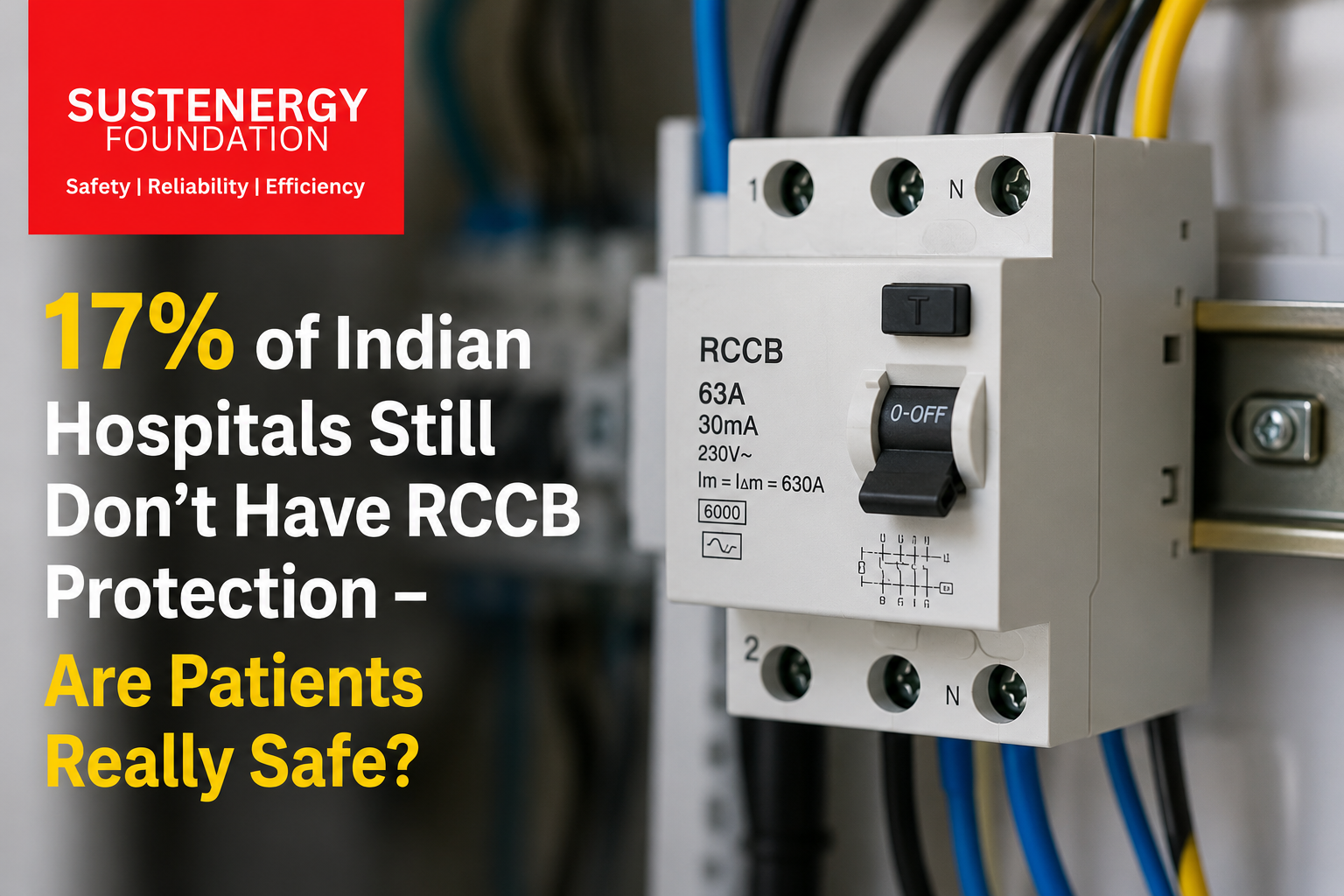
17% of the hospitals audited did not have RCCB (Residual Current Circuit Breaker) protection installed.
This raises an important question:
Are our hospitals truly electrically safe?
Why RCCB Protection is Essential in Hospitals
An RCCB (Residual Current Circuit Breaker) is one of the most important electrical safety devices in any healthcare facility.
Many people assume that Miniature Circuit Breakers (MCBs) provide complete protection. While MCBs protect electrical circuits against overloads and short circuits, they cannot detect dangerous earth leakage currents that may cause electric shock.
An RCCB continuously compares the current flowing through the phase and neutral conductors.
Under normal operating conditions, both currents remain equal.
However, if electricity leaks through faulty insulation, damaged equipment, or even a human body, the RCCB immediately detects the imbalance and disconnects the power supply—usually within milliseconds.
This rapid disconnection helps prevent:
- Fatal electric shocks
- Electrical fires
- Equipment damage
- Leakage current hazards
- Accidental electrocution
For hospitals, this protection can literally save lives.
Why Electrical Safety is More Critical in Hospitals
Unlike commercial buildings, hospitals house patients who are often in highly vulnerable conditions.
Many patients are:
- Connected to ventilators
- Under anesthesia
- Attached to ECG monitors
- Receiving dialysis
- Using infusion pumps
- Connected to invasive medical equipment
Even a very small leakage current can become dangerous when a patient is connected to medical devices.
Healthcare professionals also work around electrical equipment throughout the day.
Without proper hospital electrical protection systems, even a minor electrical fault can result in serious consequences.
This is why Electrical Safety Audits for hospitals place significant emphasis on RCCB protection.
The Hidden Danger: Hospitals Without RCCB Protection
The Sustenergy Foundation study found that 17% of audited hospitals were operating without RCCB protection on important electrical circuits.
This means these hospitals relied only on conventional circuit breakers that cannot detect earth leakage.
Even more concerning, electrical safety auditors observed situations where:
- RCCBs had been bypassed after nuisance tripping.
- Faulty RCCBs had never been replaced.
- RCCBs had not been tested for several years.
- Incorrect RCCB ratings had been installed.
- Critical patient-accessible circuits lacked leakage protection.
These hidden issues often remain unnoticed until an electrical accident occurs.
Electrical safety should never be compromised for operational convenience.
Why 30 mA RCCBs Are Recommended for Human Safety
Not every RCCB provides the same level of protection.
International electrical safety standards recommend 30 mA RCCBs for protecting people against electric shock.
Some facilities install 100 mA or 300 mA RCCBs to reduce nuisance tripping.
Although these higher-rated devices may provide equipment protection in selected applications, they do not provide the same level of personal protection as a 30 mA RCCB.
For hospitals, especially in:
- Patient rooms
- Intensive Care Units (ICUs)
- Operation Theatres (OTs)
- Dialysis Units
- Laboratories
- Diagnostic departments
appropriately selected 30 mA RCCBs should be installed wherever there is a possibility of human contact with electrical equipment.
Simply Installing an RCCB Isn’t Enough
An RCCB is a protective device—but only if it works when needed.
Like every safety system, it requires periodic inspection and testing.
Professional electrical safety engineers verify RCCBs using specialized instruments such as:
- Digital Multifunction Testers
- RCD/RCCB Testers
These instruments measure:
- Actual tripping current
- Tripping time
- Overall functionality
A properly functioning 30 mA RCCB should trip within approximately 40 milliseconds during testing.
If the device fails to operate correctly or trips slowly, it should be inspected immediately and replaced if necessary.
Routine testing ensures that the RCCB will respond effectively during a real electrical fault.
RCCB Testing is a Critical Part of Hospital Electrical Safety Audits
A comprehensive Hospital Electrical Safety Audit involves much more than checking electrical panels.
Professional audits evaluate the complete electrical safety performance of the healthcare facility, including:
- Availability of RCCB protection
- Correct RCCB selection and ratings
- RCCB tripping current testing
- RCCB tripping time verification
- Earth Fault Loop Impedance (EFLI) testing
- Earthing system testing
- Protection coordination analysis
- Thermal imaging of electrical panels
- Electrical panel inspection
- Hospital electrical compliance assessment
- Preventive maintenance recommendations
These inspections help identify hidden electrical risks long before they become fire incidents or electrical accidents.
Why Every Hospital Should Prioritize Electrical Safety
Hospitals invest heavily in advanced medical technology, infection control, and patient care systems.
However, even the most advanced healthcare facility remains vulnerable if its electrical infrastructure is unsafe.
A single electrical fault can:
- Interrupt critical medical services
- Damage expensive medical equipment
- Cause electrical fires
- Endanger patients and healthcare workers
- Lead to regulatory non-compliance
- Result in significant financial losses
Electrical safety should be considered an essential part of patient safety—not merely a maintenance responsibility.
Building Safer Hospitals Through Preventive Electrical Safety
The findings from Sustenergy Foundation’s audits should serve as a wake-up call for:
- Hospital administrators
- Biomedical engineers
- Facility managers
- Electrical maintenance teams
- NABH quality professionals
Every hospital should regularly verify:
- Are RCCBs installed in all critical circuits?
- Are they rated correctly?
- Are they tested periodically?
- Are they functioning within recommended tripping limits?
Regular Hospital Electrical Safety Audits, Hospital Thermography Inspections, Earthing System Testing, and Electrical Safety Compliance Assessments significantly reduce the risk of electrical accidents.
Preventive maintenance is always less expensive than recovering from an electrical disaster.
Conclusion
The discovery that 17% of audited hospitals still lack RCCB protection highlights an important gap in hospital electrical safety across India.
An RCCB is a simple yet highly effective device that protects people from electric shock and helps reduce the risk of electrical fires.
Installing the correct 30 mA RCCBs, performing periodic testing, and conducting professional Electrical Safety Audits for hospitals can dramatically improve patient safety and ensure compliance with healthcare electrical safety standards.
Electrical safety is not just about protecting equipment—it is about protecting lives.