
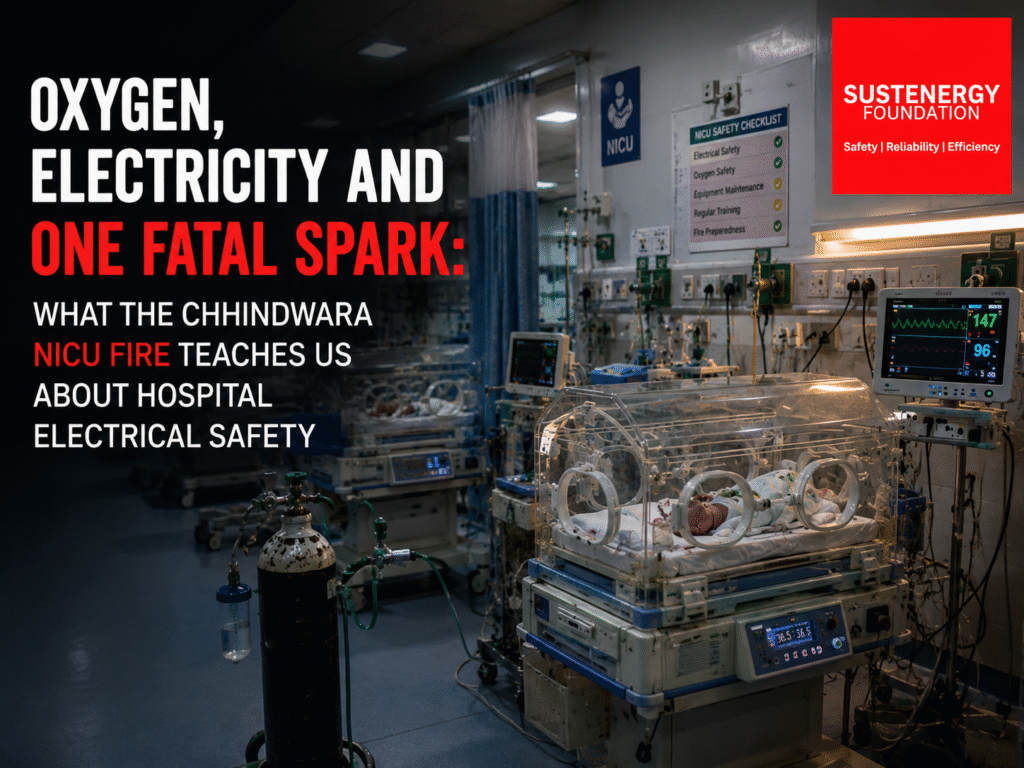
A hospital is supposed to be one of the safest places for a newborn.
But the recent fire at the Special Newborn Care Unit (SNCU) of Chhindwara Hospital, Madhya Pradesh, is a heartbreaking reminder that electrical safety in hospitals is not just about protecting equipment or preventing property damage—it is about protecting human lives.
Reports indicate that sparking from a baby warmer triggered the fire. Three newborns reportedly suffered burn injuries, and one subsequently died, although the circumstances surrounding the death are still being investigated and reports have also highlighted serious underlying medical conditions.
For families, incidents like this are devastating. For hospital management, electrical engineers, facility managers and biomedical teams, they should also be a serious warning.
A single electrical fault can take only seconds to develop into a fire.
And in a NICU or SNCU, where newborns may be receiving oxygen and are often unable to move independently, those seconds can make an enormous difference.
Why Oxygen and Electrical Equipment Require Special Attention
The incident reportedly involved a baby warmer—medical equipment that contains a heating element and operates on an electrical supply—in an environment where oxygen was being administered.
This combination deserves particular attention.
Oxygen itself does not burn. However, an oxygen-enriched environment can make ignition easier and allow fire to develop and spread much more rapidly.
That means an electrical spark, overheated component, damaged cable, loose connection or equipment failure can become far more dangerous in an oxygen-rich healthcare environment.
India’s Ministry of Health and Family Welfare has identified oxygen enrichment and electrical short circuits among the important fire hazards in healthcare facilities.
This is why hospital fire safety and hospital electrical safety must be treated as connected safety systems—not as separate responsibilities.
Having an MCB, RCCB/ELCB and a fire extinguisher is important.
But it is not enough.
Electrical Operation and Maintenance: The First Line of Defence
The best time to discover an electrical hazard is before it becomes an emergency.
Every hospital depends on a large and interconnected electrical infrastructure. This includes:
- Electrical distribution boards
- Power sockets and plugs
- Cables and wiring
- UPS systems
- Transformers
- Diesel generators
- Medical equipment supplies
- Emergency power systems
- Earthing and bonding systems
- Lighting and emergency lighting
- Critical-area electrical installations
All of these systems require systematic inspection, testing and preventive maintenance.
During routine hospital electrical maintenance, particular attention should be given to warning signs such as:
- Loose electrical connections
- Overloaded sockets and extension boards
- Damaged plugs and cables
- Deteriorated insulation
- Abnormal heating
- Poor or inadequate earthing
- Electrical leakage
- Voltage fluctuations
- Harmonics and power-quality issues
- Improper modifications
- Unauthorised electrical connections
- Repeated tripping of protective devices
These may appear to be small issues during a routine inspection.
They should not be dismissed.
A loose terminal today can become an overheated connection tomorrow. A damaged cable can eventually expose conductors. A repeatedly overloaded socket can gradually deteriorate until it becomes an ignition source.
Electrical failures often provide warning signs before they become catastrophic. The challenge is identifying those signs early.
Medical Equipment Is Not Just Another Electrical Load
One of the most important lessons for hospitals is that critical medical equipment must not be treated simply as another electrical appliance.
Baby warmers, incubators, ventilators, patient monitors, infusion pumps and other critical medical devices have specific electrical and operational requirements.
Their:
- Electrical supply
- Protective devices
- Earthing
- Isolation
- Leakage current
- Power quality
- Backup supply
- Preventive maintenance
- Manufacturer recommendations
must all be properly considered.
This is where coordination between the electrical engineering team, biomedical engineering team and facility management team becomes extremely important.
A medical device may appear to be functioning normally every day.
That does not necessarily mean its electrical condition is safe.
Maintenance History Matters More Than We Think
Electrical equipment can work perfectly for months—or even years—and still develop a dangerous fault.
Components age.
Connections loosen.
Insulation deteriorates.
Heating elements degrade.
Fans and cooling systems become less effective.
Cables are repeatedly moved or bent.
Plugs and sockets experience mechanical stress.
And sometimes, a small defect remains unnoticed until the exact moment when the equipment is under critical operating conditions.
That is why preventive electrical maintenance in hospitals is so important.
Maintenance records should not simply say that equipment was “checked.”
They should provide evidence of what was inspected, what was tested, what abnormalities were identified, what corrective action was taken and when the next inspection is due.
For critical hospital areas, maintenance documentation is part of the safety system.
Why Hospitals Need Regular Electrical Safety Audits
A hospital electrical safety audit should not be viewed as paperwork required for compliance.
It should be viewed as an opportunity to answer one critical question:
Where could our next electrical accident happen—and have we done enough to prevent it?
A comprehensive hospital electrical safety audit in India should examine the electrical installation from a safety and risk-management perspective.
This can include assessment of:
Electrical Distribution Systems
Inspection of electrical panels, distribution boards, protective devices, cables, connections and loading conditions.
Earthing and Bonding
Verification of earthing arrangements, continuity, resistance and bonding requirements relevant to the hospital installation.
Protection Systems
Assessment of MCBs, MCCBs, RCCBs/ELCBs, overload protection, short-circuit protection and other protective arrangements.
Critical Medical Areas
Special attention to NICUs, SNCUs, ICUs, operation theatres, emergency departments and other critical-care areas.
Medical Equipment Power Supply
Assessment of the electrical safety of supplies feeding critical medical equipment and coordination with biomedical engineering requirements.
Backup Power Systems
Evaluation of UPS systems, generators, emergency power supplies and changeover arrangements.
Electrical Fire Hazards
Identification of overheating, loose connections, overloaded circuits, poor-quality accessories, damaged wiring and other potential electrical ignition sources.
Documentation and Maintenance
Review of inspection records, preventive maintenance schedules, testing reports, equipment history and corrective-action records.
A good audit does not end when the auditor leaves the hospital.
The real value of an audit is what happens after the findings are identified.
Annual Electrical Safety Audits Should Become Routine Hospital Practice
Every hospital should consider conducting a comprehensive electrical safety audit at least annually through a competent and suitably qualified authority, with more frequent inspection and monitoring for high-risk areas such as NICUs, ICUs, OTs and emergency departments.
The purpose should not be to obtain a certificate and place it in a file.
The purpose should be to:
Identify → Prioritise → Correct → Verify → Close
Every significant finding should have a responsible person, a target completion date and evidence of closure.
This approach turns an electrical safety audit from a compliance exercise into a continuous hospital safety improvement process.
The Ministry of Health’s 2026 National Guidelines also emphasise systematic hazard identification, safe electrical practices, oxygen safety, functional detection and alarm systems, staff training, emergency drills, audits and continuous improvement in NICU fire safety.
The message is clear:
Hospitals need to identify hazards before an emergency identifies them for us.
Hospital Fire Safety Is Everyone’s Responsibility
It is easy to think of fire safety as the responsibility of the fire and safety department.
But a hospital’s safety chain is much larger.
Electrical engineers are responsible for safe electrical design, protection, testing and maintenance.
Biomedical engineers play a critical role in ensuring the electrical safety and maintenance of medical equipment.
Facility managers coordinate infrastructure, maintenance and operational safety.
Clinical staff need to understand equipment-related risks and emergency procedures.
Hospital administrators must provide the resources, systems and accountability required to keep the facility safe.
And everyone needs to know what to do when something goes wrong.
Because in a hospital emergency, there may be no time to search for a procedure manual.
The Real Lesson From the Chhindwara NICU Fire
The most important lesson is not simply that a particular piece of equipment may have sparked.
The deeper lesson is that hospital electrical safety must be proactive rather than reactive.
A spark lasts a fraction of a second.
The consequences can last a lifetime.
Good electrical design prevents hazards.
Good operation detects deterioration.
Good preventive maintenance reduces the possibility of failure.
Good emergency preparedness reduces the consequences when something does go wrong.
A competent hospital electrical safety audit identifies risks that routine operation may overlook.
And when the patients are newborn babies, critically ill patients or people who cannot protect themselves, there is no room for complacency.
Protecting Patients Starts With Electrical Safety
At Sustenergy Foundation, we believe that electrical safety in healthcare should be approached as a life-safety issue.
A hospital electrical safety audit should go beyond checking whether equipment is switched on and whether protective devices are installed.
It should ask deeper questions:
Is the electrical system safe?
Are critical areas adequately protected?
Is preventive maintenance actually being carried out?
Are electrical hazards being identified and corrected?
Are medical equipment and electrical systems being managed together?
Are staff prepared to respond to an electrical or fire emergency?
Most importantly:
If an electrical fault occurs today, are we confident that the hospital is prepared to protect its patients?
That is the standard every healthcare facility should strive for.
Because ultimately, hospital electrical safety is not about protecting wires, panels or equipment.
It is about protecting patients who cannot protect themselves.
Hospital Electrical Safety Audit India
If your hospital, nursing home or healthcare facility requires a systematic assessment of its electrical safety, a Hospital Electrical Safety Audit can help identify electrical hazards, assess critical systems and prioritise corrective actions before they become serious incidents.
Learn more about Hospital Electrical Safety Audit India and electrical safety services for healthcare facilities from Sustenergy Foundation.
Safety begins before the spark.