
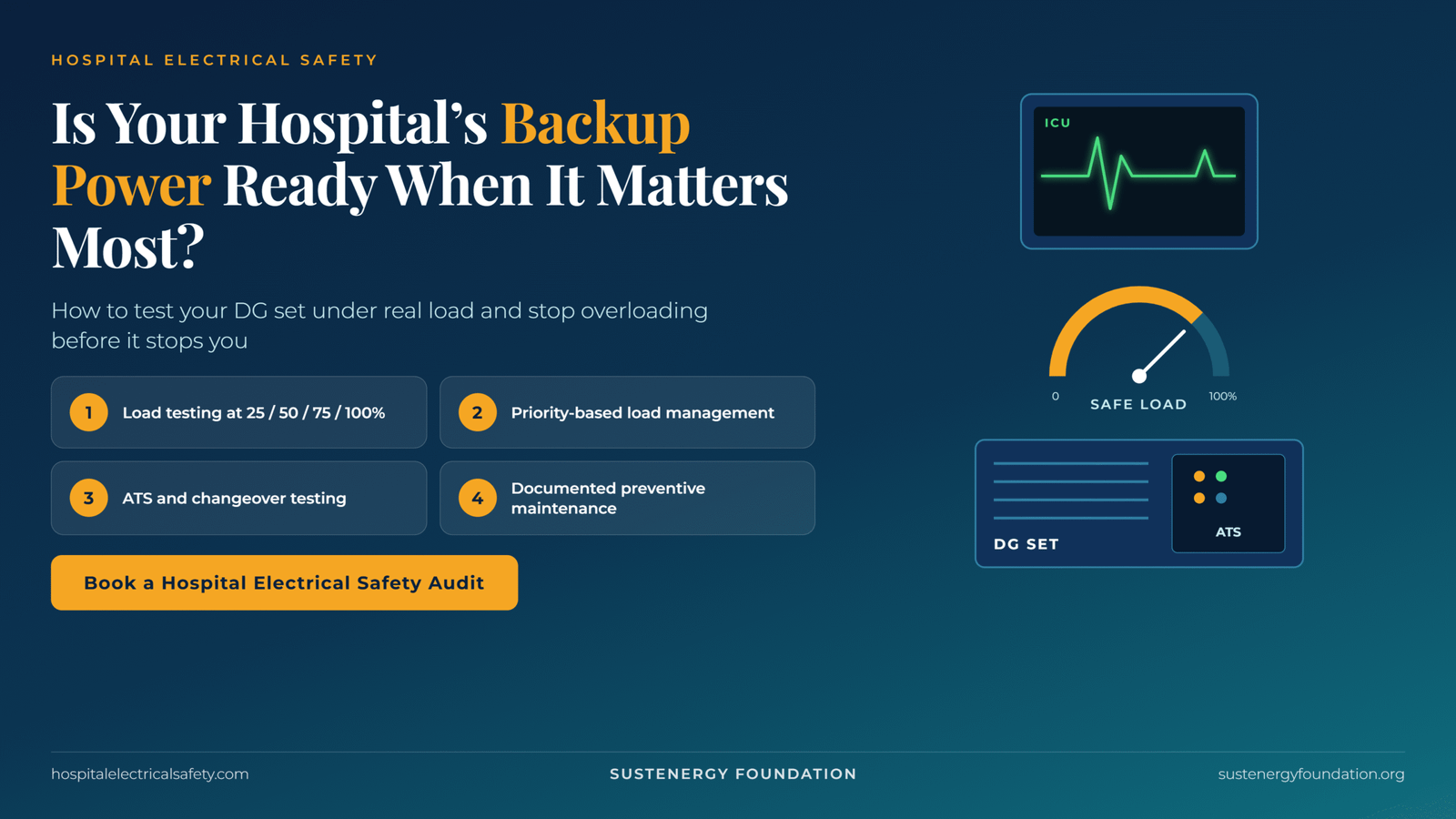
How to test your DG set under real load and stop overloading before it stops you
When the mains fails at 2 a.m., nobody in the ICU is thinking about your generator. They’re watching a ventilator, a monitor, a syringe pump. They assume the lights stay on. Your job in hospital engineering is to make sure that assumption is always true.
Having a Diesel Generator (DG) set on site is not the same as having reliable emergency power. A DG that starts fine on a Sunday morning test can still stall, trip or shut down when a real hospital load hits it. That is why hospital generator performance testing is a core part of any hospital electrical safety audit, not an optional extra.
Here is how to verify that your emergency power will perform under pressure, and how to keep your DG from being overloaded in the first place.
1. Start with the load, not the generator
Before testing anything, check whether your DG is the right size for what it actually has to carry. Many hospitals have added MRI suites, new ICU beds, extra OTs and bigger HVAC plants over the years, while the generator stayed the same.
Build a current emergency load inventory that covers:
- ICU, NICU and ventilator circuits
- Operation theatres and recovery rooms
- Medical gas plant and vacuum systems
- Emergency and critical-area lighting
- Essential lifts and fire protection systems
- Critical laboratory, blood bank and diagnostic equipment
- Essential HVAC and electrical services
Then work out the connected load, the maximum demand and the starting currents. Pay special attention to motors, compressors, pumps and chillers, because they pull far more current when starting than when running.
Evaluate the DG in both kVA and kW, taking into account its rated power factor, site ambient conditions, permissible loading and the manufacturer’s specifications. Never judge adequacy by connected load alone. It’s one of the most common mistakes, and one of the most expensive.
2. Test under realistic conditions, not just idle runs
A generator that starts without load has proved very little. What matters is how it behaves when the load arrives.
Use a suitable load bank, or an approved hospital load-testing arrangement, and check performance at roughly 25%, 50%, 75% and 100% of the applicable rated capacity, always within the manufacturer’s recommendations.
While the test runs, keep an eye on:
- Voltage and frequency
- Phase-wise current and load balance
- kW, kVA and power factor
- Engine temperature and oil pressure
- Battery charging and starting performance
- Voltage and frequency recovery after load changes
Also check how the DG handles sequential load blocks. After a power failure, several big motors and essential systems may try to restart together, and this is exactly when unacceptable voltage and frequency dips show up.
One firm rule: never run a full-load test by randomly plugging in hospital equipment. Patient safety and continuity of care always come first.
3. Prevent DG overloading with smart load management
If you take only one idea from this article, make it this: overloading is the quiet killer of hospital backup power. Push a DG beyond its safe capacity and you risk voltage or frequency instability, protective trips or a sudden shutdown.
The fix is to decide in advance what gets power first. Sort your emergency loads into clear priority tiers:
- Priority 1, Life Safety: ventilators, ICU equipment, emergency lighting, medical gas systems and other essential patient-care equipment
- Priority 2, Critical Clinical Services: operation theatres, essential laboratory equipment, blood bank systems and critical medical support services
- Priority 3, Supporting Services: selected HVAC, non-critical pumps and other loads that can safely wait
Where it makes sense, install or configure an Automatic Load Management System (ALMS). It sheds lower-priority loads as the DG approaches its limit, protects the essential loads and restores the rest in a controlled sequence once capacity is available.
Also avoid starting large motors, pumps, compressors and HVAC equipment all at once. Sequential starting and automatic load shedding cut transient loading and prevent nuisance tripping. For hospitals looking at a longer-term view of power resilience, sustainable energy solutions such as solar integration and energy-efficient upgrades can also reduce the burden on the DG.
4. Don’t forget the ATS
You can have a perfectly healthy generator and still lose power if the Automatic Transfer Switch (ATS) fails to do its job.
Run periodic simulated mains failure tests and confirm that:
- The DG starts automatically when the mains fails
- The ATS transfers the designated emergency loads correctly
- Essential circuits get power within the required transfer time
- The system stays stable under operating load
- Retransfer to the utility is smooth and controlled when the mains returns
Inspect the ATS contacts, control circuits, interlocks, sensing arrangements and mechanical operation as well. The transfer mechanism is a single point of failure that is easy to overlook.
5. Build a testing and maintenance routine that actually sticks
Reliable emergency power comes from steady, documented discipline, not occasional generator runs.
- Follow a written schedule for no-load and loaded runs, battery condition, fuel quality and availability, coolant, lubrication, filters, exhaust systems and electrical connections.
- Keep a DG performance log that records load percentage, running hours, voltage, frequency, fuel consumption, alarms, trips and corrective actions.
- Run integrated failure simulations that test the whole chain: utility failure, DG start, ATS operation, emergency load pickup and stable power delivery.
Good records also make your next audit, whether internal, external or for electrical safety compliance, much faster and easier.
Quick recap
Hospital emergency power reliability depends on more than generator size. It takes:
- An accurate load assessment
- Realistic load testing
- Clear load prioritisation and load shedding
- A tested ATS and changeover system
- Documented preventive maintenance
Above all, make sure your DG is never exposed to uncontrolled overloading. A strong load management strategy, backed by regular testing and good records, protects both your equipment and your patients.
Emergency power should never exist only on paper. It has to work, every time, for the people who depend on it. If you’re unsure where your hospital stands, a professional hospital electrical safety audit in India is a practical place to start. For wider energy efficiency and reliability planning, explore the work of Sustenergy Foundation, a sustainable energy solutions company.