
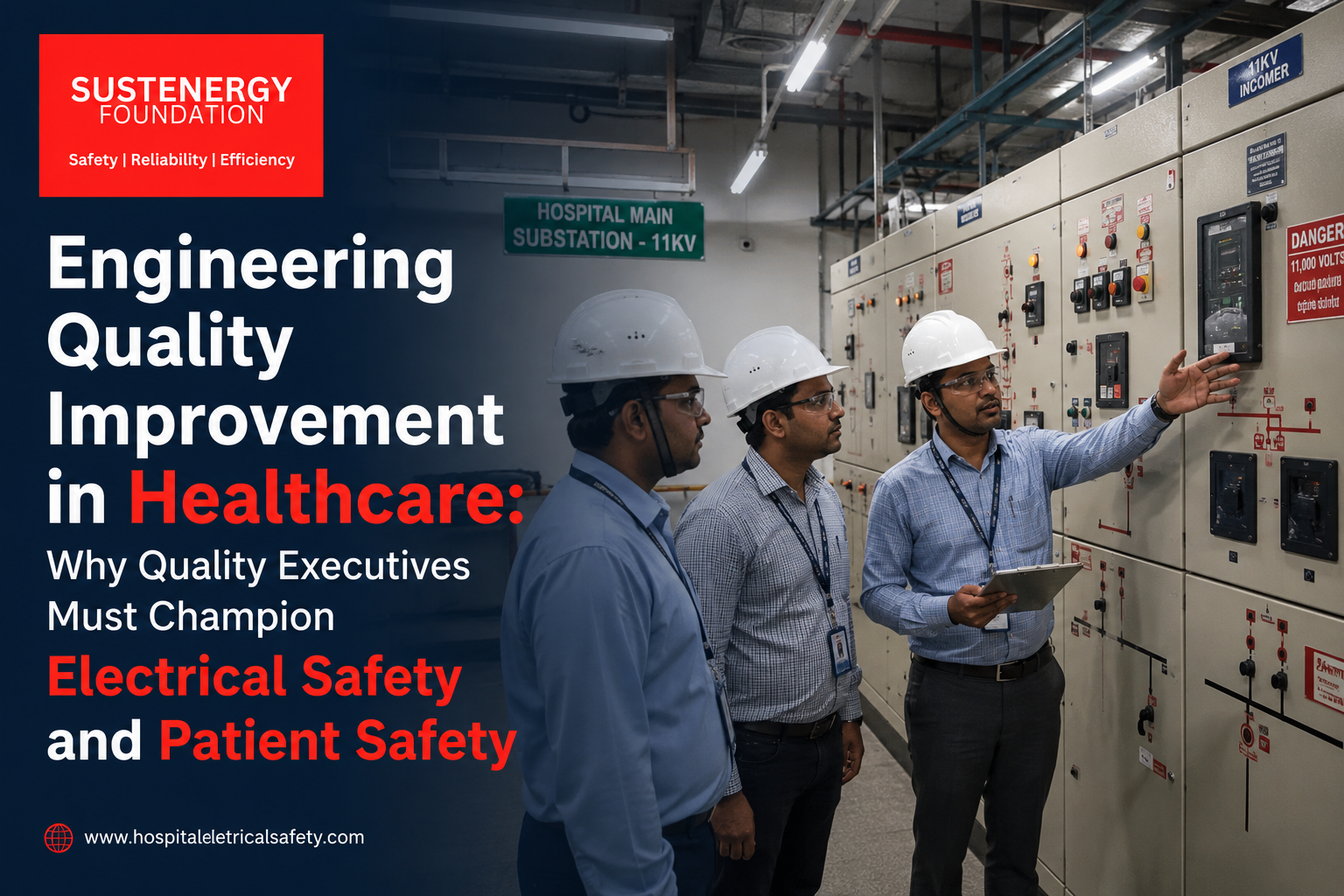
Healthcare Quality Isn’t Just Clinical—It’s Engineering Too
When we talk about healthcare quality, most people immediately think of excellent doctors, patient care, infection control, NABH accreditation, and patient satisfaction scores.
But behind every successful hospital is something equally important—its engineering infrastructure.
Every ICU ventilator, operation theatre, MRI scanner, nurse call system, HVAC unit, and life-support device depends on one critical factor: a safe and reliable engineering environment.
A single electrical failure can interrupt patient care. An overheating electrical panel can trigger a fire. A poorly maintained HVAC system can compromise infection control and patient safety.
This is why modern hospitals are increasingly recognizing that engineering quality is not just a maintenance responsibility—it is a patient safety priority.
Leading hospitals across the world actively involve Quality Executives in Electrical Safety Audits, Fire Audits, Reliability Assessments, and Engineering Improvement Programs because they understand a simple truth:
Engineering failures are patient safety failures.
The Hidden Link Between Engineering Systems and Patient Safety
Patients rarely see the engineering systems that support their care.
Yet every patient in an ICU, Operation Theatre, or Emergency Department depends on:
- Reliable electrical power
- UPS backup systems
- Proper earthing systems
- Functional medical equipment
- HVAC systems
- Fire-safe infrastructure
- Emergency generators
When any of these systems fail, the impact can be immediate and severe.
Examples include:
- Ventilator shutdown due to UPS failure
- Electrical shock incidents in patient areas
- Fire outbreaks caused by electrical faults
- MRI equipment malfunction due to poor power quality
- Operation theatre closure because of HVAC failure
The good news is that most of these incidents are preventable through proactive engineering quality improvement.
Why Quality Executives Must Be Involved in Engineering Safety
Traditionally, engineering teams have managed hospital infrastructure independently.
However, progressive hospitals now recognize that Quality Departments play a crucial role in engineering risk management.
Quality Executives bring:
- Structured monitoring
- Compliance oversight
- Risk assessment
- Corrective action tracking
- Continuous improvement methodologies
Their involvement helps ensure that engineering issues are identified and resolved before they affect patient care.
Instead of viewing engineering as a separate department, successful hospitals treat Engineering and Quality as strategic partners working toward the same goal—patient safety.
Electrical Safety: One of the Most Important Quality Indicators
Hospitals are among the most electrically intensive buildings in the world.
A typical healthcare facility contains:
- LT Panels
- HT Systems
- UPS Systems
- Diesel Generators
- Medical IT Systems
- Critical Care Equipment
- HVAC Infrastructure
Unfortunately, electrical hazards often remain hidden until a serious incident occurs.
Common issues identified during a Hospital Electrical Safety Audit include:
- Loose electrical connections
- Overloaded circuits
- Missing RCCB protection
- Poor earthing systems
- Damaged insulation
- Overheated switchboards
- Inadequate preventive maintenance
Many hospital fires in India have been traced back to electrical faults.
For this reason, Hospital Electrical Safety Audits should be viewed as a core quality requirement rather than simply a technical inspection.
How Quality Executives Can Strengthen Electrical Safety Audits
Participate in Audit Planning
Quality teams should ensure:
- Electrical Safety Audits are conducted periodically
- Critical care areas receive priority
- Previous observations are reviewed
- High-risk systems are included in the scope
Review Audit Findings Thoroughly
Important questions include:
- Were previous observations closed?
- Are recurring issues being reported?
- Which findings directly affect patient safety?
- Are risks increasing or reducing over time?
Monitor Corrective Actions
An audit creates value only when observations are effectively closed.
Quality Executives should monitor:
- Closure timelines
- Verification of corrections
- Root cause elimination
- Repeat observations
Convert Findings into Quality Metrics
Hospitals can track:
- Number of electrical safety observations
- Critical observations pending closure
- Thermal imaging hotspots
- Electrical near-miss incidents
- Equipment breakdown frequency
These indicators provide measurable insight into engineering performance.
Fire Safety Is a Quality Issue, Not Just a Compliance Requirement
Hospitals care for some of the most vulnerable occupants.
Many patients are:
- Immobile
- Sedated
- Elderly
- Dependent on life-support equipment
In such environments, even a small fire can become catastrophic.
Quality Executives should actively participate in:
Fire Audits
Review:
- Fire alarm systems
- Smoke detectors
- Fire extinguishers
- Fire doors
- Escape routes
- Electrical rooms
- DG rooms
Fire Drills
Ensure:
- Drills are conducted regularly
- Staff participation is adequate
- Lessons learned are documented
- Corrective actions are implemented
Post-Drill Reviews
Key questions include:
- Was evacuation time acceptable?
- Were communication systems effective?
- Was emergency power available?
- Were engineering teams prepared?
Engineering Improvements That Directly Improve Patient Safety
Engineering quality goes beyond inspections.
Hospitals should actively invest in infrastructure improvements.
Electrical Reliability Improvements
Examples include:
- RCCB installation and testing
- Upgrading aging electrical panels
- Thermal imaging inspections
- Improved earthing systems
- Electrical redundancy enhancements
Power Quality Improvements
Sensitive medical equipment requires:
- Stable voltage
- Low harmonics
- Continuous power supply
Recommended initiatives include:
- Power Quality Studies
- Harmonic Analysis
- UPS Health Monitoring
- Transformer Performance Reviews
HVAC Performance Optimization
HVAC systems affect:
- Infection prevention
- OT sterility
- Indoor air quality
- Patient comfort
Quality teams should monitor:
- Temperature control
- Humidity levels
- Air changes per hour
- Pressure differentials
Learning from Failures Through Root Cause Analysis
Every engineering failure provides an opportunity for improvement.
Unfortunately, many hospitals focus only on restoring equipment rather than understanding why it failed.
A better approach is to perform:
Breakdown Analysis
Ask:
- What failed?
- Why did it fail?
- Was it preventable?
- Has it happened before?
Root Cause Analysis (RCA)
Quality Executives should actively participate in RCA sessions.
The objective is not to assign blame.
The objective is to identify:
- Process weaknesses
- Training gaps
- Design limitations
- Maintenance deficiencies
- Human factors
For example, if a UPS system fails, the root cause may not simply be battery failure.
It could involve:
- Missed maintenance schedules
- Delayed replacement plans
- Inadequate testing
- Budget constraints
- Ignored warning signs
True improvement begins when the actual root cause is addressed.
Energy Efficiency Is Also a Quality Improvement Initiative
Modern healthcare quality includes sustainability.
Hospitals are among the largest consumers of electricity in the commercial sector.
Improving energy performance can deliver:
- Lower operating costs
- Better equipment reliability
- Reduced carbon emissions
- Enhanced sustainability performance
Supporting Hospital Energy Audits
Regular Hospital Energy Audits help:
- Identify energy wastage
- Optimize HVAC systems
- Improve equipment efficiency
- Reduce operating expenses
Energy KPIs for Quality Dashboards
Hospitals can track:
- Energy consumption per occupied bed
- HVAC efficiency
- DG fuel consumption
- Renewable energy contribution
- Energy cost per patient
These metrics encourage data-driven decision-making and continuous improvement.
Why Training Engineering Teams Matters
Technology, regulations, and accreditation standards continue to evolve.
Hospitals must invest in continuous learning to ensure engineering teams remain competent and confident.
Key Training Areas
Electrical Safety Training
Topics include:
- RCCB testing
- Earthing systems
- Electrical hazards
- Thermal imaging
- Safe maintenance practices
Fire Safety Training
Topics include:
- Fire prevention
- Emergency response
- Fire extinguisher usage
- Alarm systems
Reliability Engineering
Topics include:
- Root Cause Analysis
- Predictive Maintenance
- Reliability-Centered Maintenance
- Failure Mode Analysis
Energy Management
Topics include:
- Energy Audits
- HVAC Optimization
- Chiller Efficiency
- Building Energy Performance
Well-trained engineering teams are better equipped to support NABH compliance, patient safety, and operational reliability.
What High-Performing Hospitals Do Differently
Leading hospitals share several common practices.
They:
- Conduct regular Hospital Electrical Safety Audits
- Perform periodic Fire Audits
- Review engineering KPIs regularly
- Monitor breakdown trends
- Invest in staff training
- Track corrective action closure
- Promote continuous improvement
Most importantly, they view engineering as a patient safety function rather than a repair department.
Creating a Culture of Engineering Excellence
A strong safety culture begins with leadership.
Hospitals should encourage:
- Cross-functional collaboration
- Transparent reporting
- Preventive maintenance
- Continuous learning
- Incident investigations
- Engineering innovation
When Engineering and Quality teams work together, hospitals achieve:
- Safer patient environments
- Better clinical outcomes
- Higher accreditation scores
- Improved reliability
- Greater operational efficiency
Conclusion
Healthcare quality is about much more than clinical excellence.
Every electrical panel, UPS system, HVAC unit, fire alarm, and engineering decision plays a role in patient safety.
By actively participating in:
- Hospital Electrical Safety Audits
- Fire Safety Audits
- Engineering Inspections
- Root Cause Analysis
- Reliability Improvement Programs
- Energy Audits
- Staff Training Initiatives
Quality Executives can help transform engineering departments from reactive maintenance teams into proactive patient safety partners.
The world’s best hospitals do not wait for failures to occur.
They inspect.
They train.
They improve.
They prevent.
Because ultimately, engineering quality is not about infrastructure alone.
It is about protecting patients, safeguarding healthcare workers, and saving lives.