
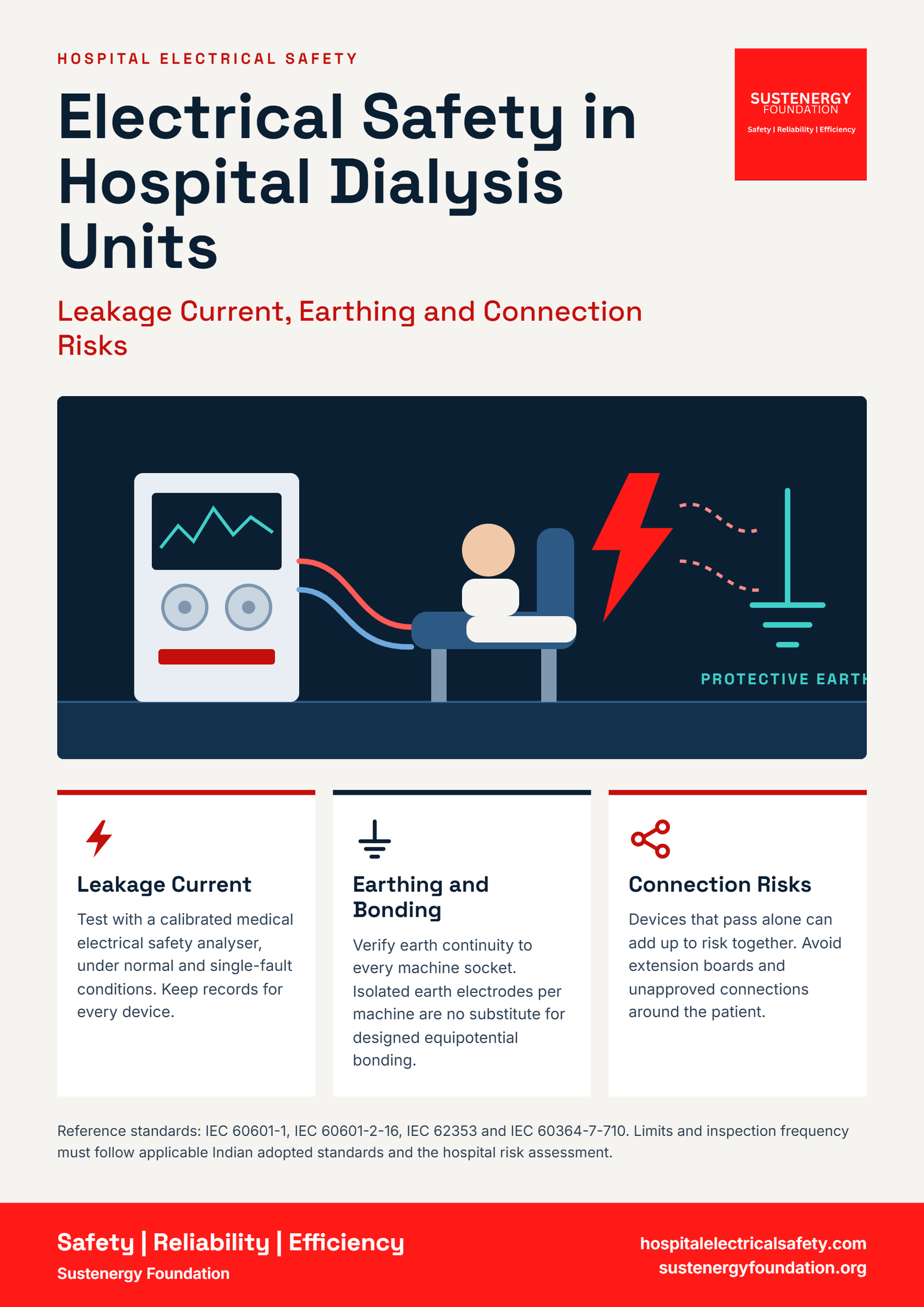
Picture a patient settling into a dialysis chair for a four-hour session. Their blood is moving through a circuit outside the body. Around them sit a haemodialysis machine, an infusion pump, a monitor, and a water line or two. It’s a calm, routine scene, and it’s also one of the most electrically sensitive environments in any hospital.
For hospital engineers, keeping a dialysis unit safe takes more than confirming that machines power on and run. The real job is to prevent electric shock, keep leakage current under control, maintain solid protective earthing, and make sure everything plugged in around the patient works safely as a whole. A regular hospital electrical safety audit is often the best way to catch problems that daily operation never shows.
1. Know What’s Around the Patient
A typical haemodialysis station can include:
- A haemodialysis machine with a blood pump, dialysate pump, heater and ultrafiltration control
- Conductivity and temperature monitoring
- Arterial and venous pressure monitoring
- Air bubble detection with automatic venous line clamping
- Dialysis chairs or beds and patient monitors
- Infusion pumps, ECG monitors and emergency equipment
- An RO water treatment plant, distribution pumps and dialysis water circulation systems
- Central acid and bicarbonate concentrate delivery, where installed
Put electricity, water, saline, exposed connections and vascular access together and you get a setting where even a small electrical fault deserves a proper look. A minor leakage issue should never be brushed off as a nuisance.
2. Leakage Current: Small Number, Big Consequence
Leakage current is electrical current that flows where it shouldn’t: through insulation, enclosures, the protective earth, or patient connections.
In dialysis units it can come from:
- Worn insulation in machine power supplies
- Faulty heating elements and internal pumps
- Damaged power cords and plugs
- Moisture getting into electrical enclosures
- Peripheral equipment connected the wrong way
- Leakage that builds up across several interconnected devices
Patient leakage current and touch current need special attention. Dialysis patients have blood-access connections and may be exposed to conductive fluids, so the margin for error is small.
What good practice looks like:
- Test with a calibrated medical electrical safety analyser
- Measure protective earth resistance, equipment leakage current and patient leakage current as relevant to each device’s classification
- Test under normal conditions and specified single-fault conditions
- Follow the manufacturer’s instructions and the applicable IEC 60601 requirements
- Keep equipment-wise leakage records and compare results against the applicable limits
- Never use an ordinary multimeter or clamp meter in place of a medical electrical safety analyser for formal leakage testing
Consistent testing and record-keeping is a core part of any electrical safety audit for hospitals in India.
3. Earthing and Equipotential Bonding
Good earthing is what protects patients and staff when something goes wrong. Your team should verify:
- Protective earth continuity from the distribution board to every dialysis machine socket
- The condition of earth conductors, plug connections and socket terminals
- Proper bonding of metallic equipment enclosures
- Earthing of RO plant motors, electrical panels and associated pumps
- Equipotential bonding of relevant accessible conductive parts, as the medical-location design requires
One common shortcut needs calling out: installing separate, isolated earth electrodes for individual dialysis machines. This is not a substitute for the designed protective earthing and equipotential bonding system. A medical location needs one coordinated earthing arrangement.
IEC 60364-7-710 covers supplementary protective equipotential bonding in relevant Group 1 and Group 2 locations. It also addresses resistance between simultaneously accessible conductive parts and bonding points, including a 0.2 Ω requirement in its specified application. Before you fix acceptance criteria, check the adopted national standard and local regulations that apply to your facility. A properly planned hospital earthing and bonding audit helps confirm what is actually installed matches what was designed.
4. When Good Devices Make a Risky System
Here’s the problem that gets missed most often. A dialysis machine, an ECG monitor, an infusion pump and a computer may each pass their own safety test. Connected together around one patient, they can still add up to extra leakage current or electromagnetic compatibility trouble.
Engineering teams can reduce this risk by:
- Avoiding unauthorised extension boards and domestic multi-plug adaptors
- Making sure sockets are correctly rated, identified and protected
- Confirming essential equipment is on the designated emergency supply
- Inspecting plugs, cables, socket outlets and cable routing for damage
- Keeping power connections away from water leaks and cleaning fluids
- Assessing interconnected equipment as a medical electrical system where applicable
- Requiring biomedical engineering approval for any modification or added connection
- Never assuming that a UPS or generator connection makes an installation safe on its own
Safe power infrastructure matters as much as safe devices. Organisations such as Sustenergy Foundation work on sustainable energy solutions, and reliable, well-designed electrical systems are part of that bigger picture for healthcare facilities.
The Takeaway
Dialysis electrical safety isn’t only about looking after machines. It means managing electrical distribution, protective earthing, leakage current, water treatment infrastructure and interconnected equipment together. A machine can be fully functional while the electrical environment around it is not.
Hospital engineering teams should work closely with biomedical engineers, nephrologists and electrical safety professionals to find hidden risks, document test results, and fix defects before they ever touch patient care. If you’re planning a structured review, a professional hospital electrical safety audit in India is a good place to start, and you can learn more about the team behind it at Sustenergy Foundation, a sustainable energy solution company.
Technical References
- IEC 60601-2-16:2025: Particular requirements for basic safety and essential performance of haemodialysis, haemodiafiltration and haemofiltration equipment
- IEC 60364-7-710: Electrical installations in medical locations, including protective earthing and supplementary equipotential bonding
- IEC 62353: Recurrent testing and testing after repair of medical electrical equipment
- IEC 60601-1: General requirements for basic safety and essential performance of medical electrical equipment
Note: Exact medical-location classification, test limits and inspection frequency must be set using the applicable Indian adopted standards, current regulations, equipment instructions and the hospital’s clinical risk assessment.