
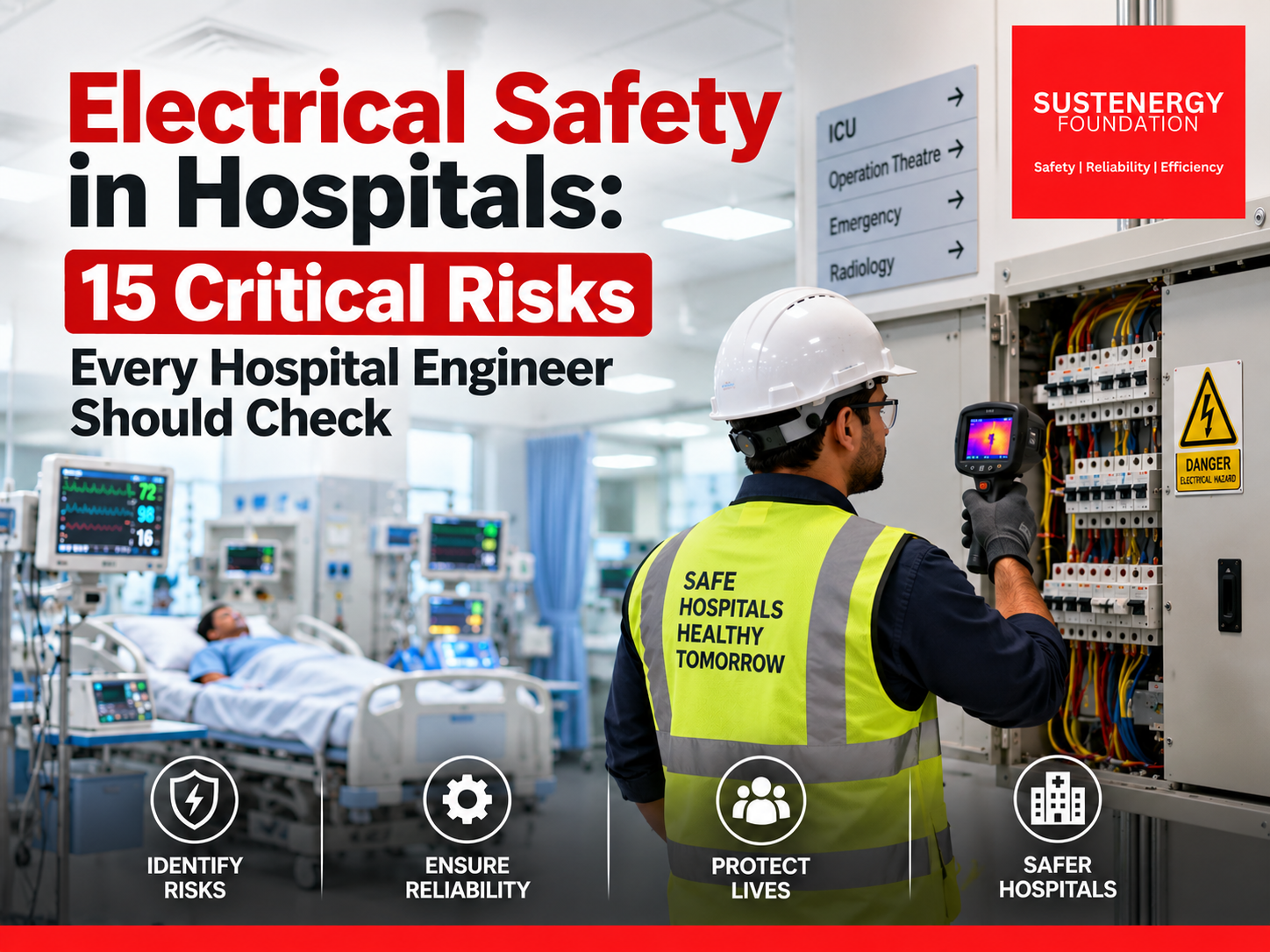
A hospital is not an ordinary commercial building when it comes to electrical safety.
Electricity is needed everywhere—from operating theatres and ICUs to diagnostic equipment, laboratories, patient rooms, pharmacies and administrative areas. More importantly, many patients depend on electrically powered medical equipment to support diagnosis, treatment and even life support.
This is why a small electrical defect that might be inconvenient in an office can become a serious patient-safety risk in a hospital.
A proper hospital electrical safety audit is therefore much more than checking whether lights are working or whether electrical panels look clean. Engineers need to look at the complete electrical system, including earthing, shock protection, fault protection, emergency power, UPS systems, medical IT systems, equipotential bonding, power quality and maintenance practices.
For hospitals in India, a systematic hospital electrical safety audit in India can help identify hidden risks before they contribute to an electrical shock, equipment failure, fire or interruption to critical patient-care services.
Here are 15 important risks that every hospital engineer should routinely check.
1. Inadequate or Defective Earthing
Earthing is one of the foundations of electrical safety, but it is also one of the areas where problems can remain unnoticed for a long time.
During a hospital earthing system audit, engineers should check earth continuity, earth resistance, protective conductors, bonding connections, corrosion, loose connections and the physical condition of earth electrodes.
Every exposed conductive part that requires protection should have an effective connection to the protective earthing system.
A good earth connection is not just a number recorded in a test report—it is part of the protection system that helps ensure a fault is cleared safely.
2. High Earth Fault Loop Impedance
An electrical protective device can only disconnect a fault effectively if the fault current is sufficient to operate it within the required time.
Excessive earth fault loop impedance (EFLI) can restrict fault current and potentially delay protective-device operation.
During an electrical safety audit for hospitals, engineers should measure loop impedance at appropriate points and compare the results with the requirements applicable to the circuit and protective device.
High loop impedance should not simply be recorded as an observation. The underlying cause should be investigated and corrective action taken.
3. Missing or Inadequate Equipotential Bonding
Hospitals contain many conductive services—medical gas pipelines, water pipes, structural metalwork, equipment enclosures and other metallic systems.
In medical locations, particularly Group 2 medical locations, equipotential bonding becomes especially important.
A hospital electrical inspection should verify that relevant conductive parts are properly bonded and that bonding connections are continuous, secure and appropriately identified.
Poor bonding can increase the potential difference between conductive parts during an electrical fault.
4. RCCB/RCBO Protection Problems
Residual-current protection can provide an important layer of protection against electric shock and earth leakage, but simply having an RCCB installed does not mean the circuit is safe.
During RCCB testing in hospitals, engineers should verify:
- Correct device type
- Rated residual operating current
- Circuit compatibility
- Wiring and termination
- Test-button operation
- Trip performance
- Correct upstream/downstream coordination where applicable
RCCBs, RCDs and RCBOs should be tested periodically as part of the hospital’s preventive maintenance programme.
5. Incorrect Protection in Group 2 Medical Locations
Not every part of a hospital has the same electrical-risk profile.
Operating theatres, ICUs, Cathlabs, certain dialysis areas and other Group 2 medical locations may have significantly higher electrical-safety requirements.
An effective hospital electrical safety audit should therefore verify the medical-location classification and assess whether the electrical installation is appropriate for that classification.
Depending on the application, this may include reviewing:
- Protective devices
- Medical IT systems
- Insulation monitoring
- Equipotential bonding
- Emergency supplies
- Changeover arrangements
- Protective conductors
- Critical equipment connections
A generic electrical checklist should never be the only basis for assessing a high-risk medical location.
6. Medical IT System Deficiencies
Where a medical IT system is required, it plays a critical role in maintaining continuity of supply and improving protection against certain electrical faults.
During a hospital electrical safety audit, engineers should examine the medical isolation transformer, insulation monitoring device, alarm system, protective conductors and associated wiring.
The alarm system also deserves attention.
An insulation-monitoring alarm that is permanently silenced, bypassed or routinely ignored can turn an important safety feature into little more than an indicator on a wall.
Functional testing and maintenance records should therefore be reviewed carefully.
7. Overloaded Sockets and Extension Boards
Hospitals use a large number of electrical and electronic devices, and additional equipment is frequently introduced into patient-care areas.
This can lead to overloaded sockets, multiple adaptors and excessive dependence on extension boards.
During a hospital electrical inspection, engineers should check:
- Socket loading
- Circuit capacity
- Plug and socket condition
- Extension boards
- Temporary wiring
- Damaged adaptors
- Signs of overheating
Temporary electrical arrangements should not gradually become permanent installations.
8. Poor Cable Condition and Loose Terminations
A cable may look perfectly normal from a distance while having a loose termination, damaged insulation or an improperly installed joint.
Engineers should inspect cables and terminations for:
- Damaged insulation
- Loose terminals
- Exposed conductors
- Inadequate cable glands
- Poor cable joints
- Mechanical damage
- Signs of overheating
These basic defects are often among the most practical findings during an electrical safety audit for healthcare facilities.
9. Poorly Maintained Electrical Panels
The main electrical panel is one of the most important areas to inspect in any hospital.
MSBs, SMDBs, DBs, MCCs and LDBs should be checked for loose connections, thermal hotspots, missing covers, bypassed protective devices, poor segregation, inadequate labelling and unused open ways.
A hospital electrical safety audit in India should also consider the housekeeping and accessibility around electrical panels.
An electrical panel should be easy to identify, safely accessible and properly maintained—not surrounded by stored materials or used as a convenient storage area.
10. Generator and Emergency Power Failures
A hospital cannot afford to discover that its emergency power system does not work when the normal supply fails.
Emergency power systems should be tested under realistic operating conditions.
A hospital emergency power audit should consider:
- DG sets
- AMF/ATS panels
- Emergency distribution
- Essential-power circuits
- Fuel arrangements
- Battery systems
- Generator changeover
- UPS systems
- Critical loads
The important question is not simply, “Is there a generator?”
The real question is:
Will the critical hospital loads receive reliable power when the normal supply fails?
11. UPS and Critical-Load Problems
Critical hospital departments may depend on UPS systems for continuity of power.
An effective hospital UPS power audit should examine UPS capacity, bypass arrangements, battery condition, autonomy, alarms, earthing and transfer performance.
Battery condition is particularly important. A UPS may appear healthy during normal operation but fail to provide adequate backup when subjected to an actual outage.
Critical loads should also be identified and periodically reviewed to ensure that the UPS system is not unintentionally overloaded.
12. Lightning and Surge Protection Gaps
Modern hospitals contain sensitive electronic equipment that can be affected by lightning and electrical surges.
During a hospital electrical safety assessment, engineers should inspect the lightning protection system, down conductors, earth electrodes and surge protective devices (SPDs).
The assessment should also consider whether the SPD arrangement and earthing system are appropriate for the installation.
For sensitive medical equipment, surge protection should be treated as part of the overall electrical-risk-management strategy.
13. Electrical Fires and Thermal Hotspots
Many electrical failures give warning signs before they become serious incidents.
A loose termination, overloaded circuit or deteriorating connection can generate abnormal heat.
This is why a hospital thermography electrical audit can be extremely useful.
Thermal imaging can help identify abnormal temperatures at:
- Circuit breakers
- Busbars
- Cable terminations
- Transformers
- MCC panels
- Distribution boards
- Switchgear connections
However, thermography should not simply produce a collection of thermal images. Significant hotspots should be identified, classified, investigated and rectified, with corrective actions documented.
14. Power-Quality Problems
Hospitals increasingly depend on sensitive electronic equipment, UPS systems, medical imaging equipment, VFDs and other nonlinear loads.
Poor power quality can result in equipment malfunction, overheating, nuisance tripping and reduced equipment reliability.
A comprehensive hospital energy and electrical audit may therefore include measurements of:
- Voltage variation
- Voltage unbalance
- Harmonics
- Neutral current
- Power factor
- Transients
- Frequency variations
Power-quality problems should be assessed in relation to the equipment connected to the electrical system rather than simply recording measurements without understanding their operational impact.
15. Unsafe Practices in Group 2 Medical Locations
This is perhaps one of the most important areas of a hospital electrical safety audit.
In OTs, ICUs, Cathlabs, dialysis areas, intensive-care spaces and other applicable medical locations, engineers should pay particular attention to the actual patient environment and how electrical systems interact with medical equipment.
The assessment should consider:
- Patient environment and medical-location classification
- Socket and circuit identification
- Equipotential bonding
- Protective conductor continuity
- RCD/RCCB/RCBO suitability where applicable
- Medical IT systems and insulation monitoring where required
- Emergency and UPS supplies
- Critical equipment earthing
- Leakage and touch-current considerations
- Electrical isolation procedures
- Alarm systems
- Emergency changeover arrangements
- Periodic testing and maintenance records
These checks should be supported by proper documentation and corrective-action tracking.
General Areas vs Group 2 Medical Locations: Don’t Use the Same Checklist
One of the common mistakes in hospital electrical safety is treating the entire hospital as though every area has the same electrical risk.
General areas such as offices, corridors, stores, kitchens and administrative spaces still require proper earthing, circuit protection, safe wiring, RCD protection where applicable, electrical-panel maintenance, fire protection and emergency power.
But Group 2 medical locations require a much more detailed assessment.
The reason is simple: patients may have limited ability to respond to an electrical shock, and medical procedures may involve conductive equipment, invasive connections or life-support systems.
Therefore, a professional hospital electrical safety audit checklist should distinguish between general electrical areas and medical locations.
Why Regular Hospital Electrical Safety Audits Matter
Electrical safety should not be treated as a one-time compliance exercise.
Hospitals continuously change. New medical equipment is installed, departments are renovated, electrical loads increase, temporary connections are introduced and old equipment remains in service.
A system that was safe several years ago may not necessarily remain safe today.
Regular hospital electrical inspection and testing can help identify developing problems before they become electrical incidents.
A comprehensive audit should ideally be followed by:
- Identification of deficiencies
- Risk classification
- Corrective-action recommendations
- Assignment of responsibility
- Target completion dates
- Verification of completed actions
- Periodic reassessment
This makes electrical safety a continuous process rather than a report that simply sits in a file.
Electrical Safety in Hospitals Is Ultimately Patient Safety
Electrical safety in a hospital is not simply about preventing electrical fires or avoiding equipment damage.
It is about ensuring that an electrical fault does not become a patient-safety incident.
From the main electrical panel to the OT, from the generator to the ICU UPS, and from the earthing system to the smallest patient-area socket, every part of the electrical installation has a role to play.
A systematic hospital electrical safety audit in India, supported by regular testing, thermography, preventive maintenance, proper documentation and timely corrective action, can significantly strengthen the reliability and safety of a healthcare facility.
For hospital engineers and facility teams, the goal should be simple:
Don’t wait for an electrical failure to reveal a safety problem. Find it, test it, document it and fix it before it becomes an incident.