
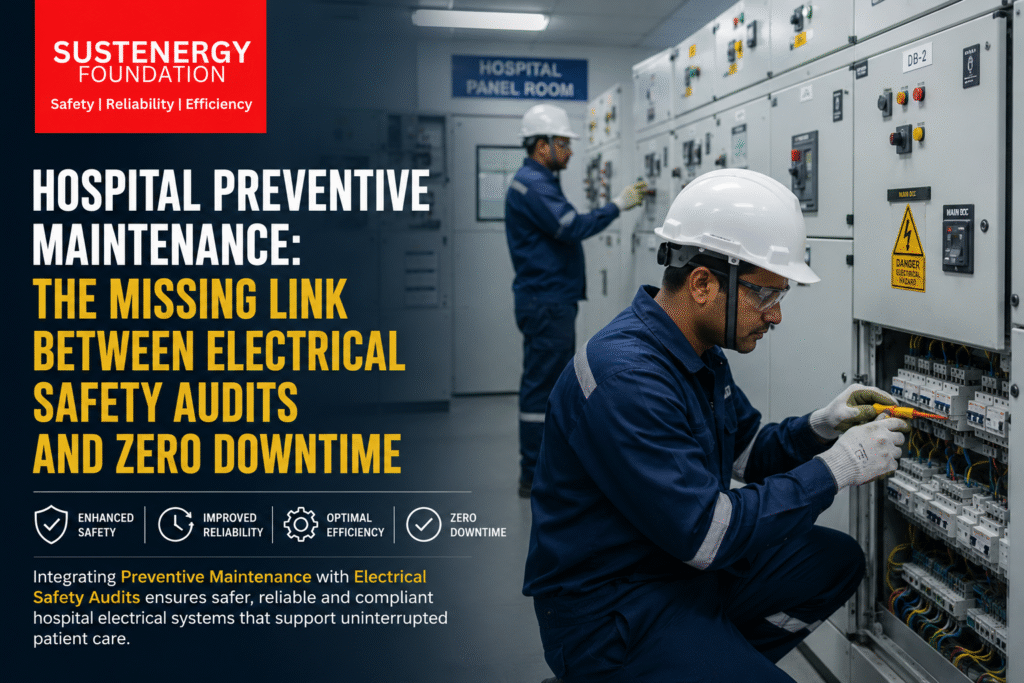
Why Preventive Maintenance and Hospital Electrical Safety Audits Must Work Together
In a hospital, electrical reliability is far more than an operational requirement—it is a patient safety necessity. Every ventilator, operating theatre, ICU monitor, MRI scanner, laboratory analyser, and emergency lighting system depends on a continuous and safe power supply. Even a few seconds of electrical interruption can affect critical patient care and put lives at risk.
While most hospitals invest significantly in modern medical equipment, backup generators, UPS systems, and advanced healthcare technologies, one crucial element is often underestimated: integrating a Hospital Preventive Maintenance (PM) Program with a comprehensive Hospital Electrical Safety Audit.
Routine maintenance keeps electrical equipment operational, but it doesn’t always reveal hidden electrical risks that develop over time. A professional Hospital Electrical Safety Audit complements preventive maintenance by identifying electrical hazards, compliance gaps, fire risks, and system weaknesses before they lead to costly failures.
For hospitals aiming to achieve zero downtime, improve patient safety, and comply with NABH requirements, preventive maintenance and electrical safety audits should always work together—not independently.
Preventive Maintenance Keeps Equipment Running
Preventive Maintenance (PM) is the backbone of any hospital engineering department. Scheduled maintenance helps extend equipment life, improve reliability, and reduce unexpected breakdowns.
Typical preventive maintenance activities include:
- Cleaning electrical panels and switchboards
- Tightening electrical terminals and busbar connections
- Servicing diesel generators (DG Sets)
- UPS preventive maintenance
- Transformer inspection and oil testing
- Battery bank inspection and testing
- HVAC electrical maintenance
- Functional testing of emergency power systems
- Inspection of Medical IT Power Systems
These routine activities are essential for maintaining day-to-day operations. However, they primarily focus on servicing individual equipment rather than assessing the safety and performance of the complete electrical distribution system.
Why Preventive Maintenance Alone Cannot Prevent Every Failure
Many hospitals assume that regular preventive maintenance guarantees uninterrupted electrical operation.
Unfortunately, real-world experience tells a different story.
Electrical failures often occur even in hospitals with established maintenance schedules because some risks remain hidden until they cause a major incident.
Examples include:
- Loose internal electrical connections
- Overloaded transformers
- Incorrect protection relay settings
- High earth resistance
- Poor earthing and bonding systems
- Improper cable sizing
- Harmonic distortion from modern medical equipment
- Aging switchgear and distribution panels
- Voltage imbalance
- Inadequate protection coordination
These issues are rarely identified during routine maintenance but are common findings during a professional Hospital Electrical Safety Audit.
How a Hospital Electrical Safety Audit Makes the Difference
Unlike routine maintenance, a Hospital Electrical Safety Audit evaluates the entire electrical infrastructure from a safety, reliability, and compliance perspective.
A comprehensive electrical safety audit for hospitals typically includes:
- Electrical system compliance assessment
- Earthing and bonding system evaluation
- Lightning protection system inspection
- Transformer loading analysis
- DG synchronization verification
- Protection coordination studies
- Earth Fault Loop Impedance (EFLI) testing
- RCCB testing and performance evaluation
- Infrared thermography of electrical panels
- Cable sizing verification
- Power quality analysis
- Harmonic distortion measurement
- Voltage imbalance analysis
- Electrical fire risk assessment
These assessments help identify hidden defects before they develop into major failures, protecting both patients and hospital operations.
The Formula for Zero Downtime
Hospitals that achieve exceptional electrical reliability follow a simple strategy:
Preventive Maintenance + Hospital Electrical Safety Audit = Safe, Reliable, and Resilient Electrical Infrastructure
Preventive maintenance ensures equipment continues to perform efficiently.
A Hospital Electrical Safety Audit confirms that the entire electrical network is:
- Safe
- Reliable
- Energy efficient
- Statutory compliant
- Future-ready
Together, they significantly reduce the risk of:
- Electrical fires
- Transformer failures
- UPS shutdowns
- Generator failures
- Operating Theatre (OT) power interruptions
- ICU electrical failures
- Diagnostic equipment downtime
- Unexpected electrical outages
The result is improved patient safety, higher equipment availability, and uninterrupted healthcare services.
Moving Towards Predictive Maintenance
Modern hospitals are increasingly adopting predictive maintenance alongside preventive maintenance.
Instead of waiting for equipment to fail or relying solely on scheduled servicing, predictive maintenance uses advanced diagnostic technologies to detect developing problems early.
These technologies include:
- Infrared Thermography
- Power Quality Analysis
- Partial Discharge Monitoring
- Transformer Health Assessment
- Battery Impedance Testing
- Ultrasonic Inspection
- Arc Flash Risk Assessment
- Load Balancing Studies
These advanced techniques help hospital engineering teams plan maintenance before failures occur, reducing emergency shutdowns and improving overall electrical reliability.
Better Safety Also Means Better Financial Performance
Investing in hospital electrical safety audits and preventive maintenance is not simply a compliance exercise—it is a smart financial decision.
Benefits include:
- Lower emergency maintenance costs
- Reduced electrical failures
- Longer equipment life
- Lower energy consumption
- Improved power reliability
- Higher equipment availability
- Reduced insurance risks
- Lower operational downtime
- Better patient satisfaction
When hospitals reduce avoidable failures and emergency repairs, they also improve operational efficiency and protect long-term infrastructure investments.
Supporting NABH Accreditation and Regulatory Compliance
Healthcare accreditation increasingly focuses on infrastructure safety, risk management, and continuous improvement.
A documented Preventive Maintenance Program supported by periodic Hospital Electrical Safety Audits demonstrates a hospital’s commitment to:
- Patient safety
- Staff safety
- Reliable electrical infrastructure
- NABH compliance
- Electrical fire prevention
- Continuous quality improvement
The findings from an audit also provide valuable engineering insights, helping hospital management prioritise upgrades, improve budgeting, and strengthen long-term infrastructure planning.
Why Hospitals Across India Trust Sustenergy Foundation
Sustenergy Foundation is one of India’s leading specialists in Hospital Electrical Safety Audits, having successfully completed 100+ hospital electrical safety audits across India.
Our experienced engineers evaluate every critical component of a hospital’s electrical infrastructure, including:
- HT & LT Electrical Systems
- Substations
- Transformers
- LT Panels
- UPS Systems
- DG Sets
- Operating Theatre (OT) Electrical Systems
- Medical IT Systems
- Earthing Networks
- Lightning Protection Systems
- Power Quality
- Thermal Imaging (Infrared Thermography)
- Electrical Fire Risk Assessments
Our audits are designed to uncover hidden electrical risks that conventional maintenance often misses.
The recommendations we provide are practical, prioritised, and focused on improving:
- Electrical safety
- Patient safety
- System reliability
- Energy efficiency
- Regulatory compliance
- Hospital resilience
- Business continuity
Conclusion
Preventive Maintenance and Hospital Electrical Safety Audits should never be treated as separate engineering activities.
Preventive maintenance ensures that equipment continues to function properly. A Hospital Electrical Safety Audit ensures that the complete electrical system is safe, compliant, efficient, and capable of supporting uninterrupted patient care.
For hospitals striving to achieve zero downtime, strengthen electrical fire safety, maintain NABH compliance, improve energy efficiency, and protect patients, combining these two practices is no longer optional—it is essential.
At Sustenergy Foundation, we help healthcare facilities build safer, smarter, and more reliable electrical infrastructure through comprehensive Hospital Electrical Safety Audits, advanced diagnostic testing, and expert engineering recommendations.
If your hospital is committed to delivering uninterrupted patient care, now is the time to evaluate not just your equipment—but your entire electrical system.