
By Sustenergy Foundation – The Best Hospital Electrical Safety Audit Company in India
Contents of This Blog
- The Incident: Fire in the Hospital Main Electrical Panel
- How It Happened: A Chain of Preventable Failures
- The Impact: Beyond Equipment Damage
- How to Prevent It: Proactive Electrical Safety Measures
- Routine Electrical Safety Audits
- Animal-Proofing Electrical Infrastructure
- Smart Monitoring Systems
- Qualified Maintenance Teams
- Emergency Response Planning
- Routine Electrical Safety Audits
- Why Electrical Safety Audits Must Include These Risks
- Recap and Conclusion: Building Safer Hospitals with Sustenergy Foundation
The Incident: A Fire in the Hospital Main Electrical Panel
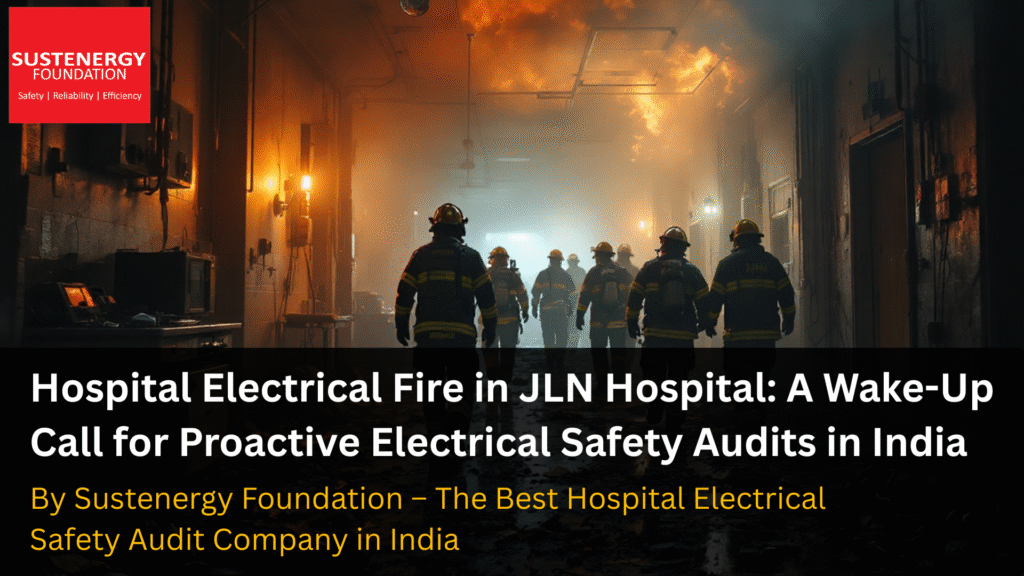
In October 2025, a fire erupted in the main power panel of JLN Hospital, near the old OPD block — a chilling reminder of the importance of regular electrical safety audits in healthcare institutions. According to reports, the fire was triggered by pigeons that entered the panel room, disturbing electrical wiring and causing a short circuit. Within minutes, smoke filled the entrance corridor, causing panic among patients, staff, and visitors.
Fortunately, the hospital’s quick response team promptly shut down the main power supply, containing the blaze before it reached critical areas such as wards and ICUs. While there were no casualties, the incident caused severe damage to electrical equipment, disrupted essential medical operations, and exposed significant infrastructure vulnerabilities.
For institutions striving to maintain safety and operational continuity, this incident underscores why partnering with the Best Hospital Electrical Safety Audit Company in India is not optional—it’s essential. Sustenergy Foundation, a Premium Electrical Safety Audit Firm in India, emphasizes the importance of regular assessments, preventive maintenance, and animal-proofing measures across hospital electrical systems.
How It Happened: A Chain of Preventable Failures
The root cause of the JLN Hospital fire was traced to a short circuit — but the real issue lay in a series of preventable failures, including:
- Animal intrusion due to unsecured electrical panels
- Exposed or poorly insulated wiring without protective shrouds
- Absence of enclosures for high-voltage components
- Lack of scheduled maintenance or inspection routines
- No early fault detection or thermal monitoring systems
Even a minor environmental factor, such as a pigeon entering a live panel, led to a chain reaction of hazards. This event is a stark lesson for hospitals across India — from Kerala to Hyderabad and Bangalore — to implement strict Electrical Safety Audit in India programs that address both internal and environmental risks.
The Impact: Beyond Equipment Damage
While the fire did not claim lives, its ripple effects were extensive:
- Disruption of critical services such as outpatient departments and diagnostic labs
- Panic among patients and staff, particularly in emergency and ICU zones
- Financial losses from equipment replacement and repair costs
- Reputational damage, affecting patient trust and hospital credibility
- Legal exposure, as hospitals must comply with safety norms under Indian electrical and fire regulations
In hospitals, where electricity sustains life-support equipment, even a momentary power disruption can prove disastrous. The event reinforces the urgent need for Hospital Electrical Safety Audits and Energy Audit Services in India to ensure uninterrupted, safe, and compliant operation.
How to Prevent It: Proactive Electrical Safety Measures
To eliminate such incidents, hospitals must adopt a zero-tolerance policy toward electrical hazards. Sustenergy Foundation recommends the following comprehensive preventive strategies:
✅ 1. Routine Electrical Safety Audits
- Conduct annual Electrical Safety Audits in India aligned with NABH and NEC standards.
- Inspect panels, wiring, grounding, and load distribution systems.
- Identify hotspots, insulation failures, and potential fire risks.
✅ 2. Animal-Proofing Electrical Infrastructure
- Install bird guards, sealed mesh covers, and dust-proof enclosures.
- Regularly inspect outdoor panels and service rooms to ensure access control.
✅ 3. Smart Monitoring Systems
- Use thermal imaging cameras, leakage current detectors, and fault alarms.
- Integrate IoT-based sensors for real-time fault detection and automated alerts.
✅ 4. Qualified Maintenance Teams
- Employ certified electrical professionals for installations and preventive maintenance.
- Train facility staff in electrical safety protocols and emergency response.
✅ 5. Emergency Response Planning
- Keep fire extinguishers and isolation switches readily accessible.
- Conduct mock drills and refresher training for all staff.
- Ensure updated evacuation plans are displayed near all electrical zones.
Through these steps, hospitals can transition from reactive damage control to proactive electrical safety management—a cornerstone of operational reliability and patient safety.
Why Electrical Safety Audits Must Include These Risks
Traditional audits often prioritize load balancing, transformer efficiency, or energy conservation. However, the JLN Hospital fire reveals the need to broaden the scope of audits. Comprehensive hospital audits must evaluate:
- Environmental intrusion risks (birds, rodents, humidity, dust)
- Panel enclosure integrity and accessibility
- Readiness for emergency power isolation
- Compliance with hospital-specific NABH safety standards
- Preventive maintenance record verification
Sustenergy Foundation’s Electrical Safety Audit in Kerala, Electrical Safety Audit in Hyderabad, and Electrical Safety Audit in Bangalore programs already include these risk dimensions, ensuring that hospitals are protected against overlooked environmental and operational hazards.
By incorporating these areas into every Electrical Safety Audit, institutions can identify latent issues before they escalate into fires or power failures—saving both lives and infrastructure.
Recap and Conclusion: Sustenergy Foundation’s Commitment to Safer Hospitals
The JLN Hospital fire was a critical warning. It demonstrated how a single oversight—like an open electrical panel or an unprotected wire—can trigger widespread disruption. Fortunately, timely intervention prevented casualties, but the incident highlights a systemic issue across Indian hospitals: electrical safety remains reactive, not preventive.
Hospitals must integrate Electrical Safety Audits, Energy Audit Services in India, and continuous monitoring into their operational framework. Doing so not only ensures compliance but also reinforces patient trust and institutional resilience.
At Sustenergy Foundation, India’s largest Electrical Safety Audit Service Provider, we are committed to creating safer, more sustainable healthcare environments. As the Top Electrical Safety Audit Firm in India and the Best Hospital Electrical Safety Firm, we combine technical excellence, real-world experience, and data-driven insights to safeguard lives and assets.
Because in healthcare, safety isn’t optional—it’s essential. And with Sustenergy Foundation, the power to prevent the next electrical fire truly lies in our hands.
Prepared by Sreelakshmi. S Head – Engineering
Reviewed and approved by Jayakumar Nair, Managing Director